

There are 390,520 doctors on the GMC register (Professional Standards Authority, 2024). The vast majority work in the NHS. A growing number are adding aesthetic medicine to their careers, and they’re finding it solves more than one problem at once.
You didn’t spend five or six years at medical school to feel burned out by year three of practice. But that’s exactly where many doctors find themselves. Aesthetics won’t fix the systemic pressures in the NHS. What it can do is give you a clinical outlet that pays well, runs on your terms, and still uses the skills you trained for.
This guide breaks down why doctors are so well-positioned for aesthetic medicine, what the earning potential looks like, and what training actually involves.
Key Takeaways
- 80% of UK doctors score at high or very high risk of burnout (BMA, 2024) – and 74% told the GMC they’re likely to change careers in the next 12 months
- Self-employed aesthetic practitioners earn £60,000–£150,000+, on top of or instead of NHS income
- Doctors can prescribe independently from graduation – no additional prescriber qualification needed, unlike nurses or pharmacists
- The UK aesthetics market is worth £3.6 billion and growing at 8–9% annually (AestheticSource, 2026)

Why Are So Many Doctors Exploring Aesthetics?
The numbers tell the story. In the BMA’s 2024 mental health survey of 4,300 doctors, 80% scored at high or very high risk of burnout using the Oldenburg Burnout Inventory (BMA, 2024). Among junior doctors, that figure hits 91%. Among GP partners, it’s 88%.
Those aren’t outliers. The GMC’s own 2025 Workplace Experiences Report found that 74% of doctors are likely to make a career change in the next 12 months, and 15% are taking concrete steps to leave UK medicine entirely – more than double the 7% who said the same in 2021 (GMC, 2025). In 2024, 4,880 doctors left the workforce, a 26% increase on the previous year (GMC Workforce Report, 2025).
Aesthetic medicine isn’t an escape from clinical work. It’s a redirection of it. The UK aesthetics market is worth an estimated £3.6 billion and growing at 8–9% year on year (AestheticSource, 2026). Around 900,000 anti-wrinkle injection treatments are performed annually in the UK (PolicyBee, 2025). Patients are actively seeking out qualified medical professionals to deliver these treatments. And doctors, with their prescribing rights and diagnostic training, are the best-qualified professionals to step in.
Is this what you imagined when you started medical school? Probably not. But the career you planned and the one that makes you feel fulfilled don’t have to be the same thing.
What Advantages Do Doctors Have in Aesthetics?
Doctors have one advantage that many other professions can’t match: you can prescribe independently from the day you graduate. You don’t need a separate independent prescriber qualification. For aesthetic medicine, that’s significant. Anti-wrinkle injections are prescription-only medicines, and the prescriber must now conduct a face-to-face physical examination before prescribing (GMC, 2025). As a doctor, you can do both: prescribe and administer in the same consultation.
Nurses, pharmacists, and other eligible professionals need to complete additional prescriber training before they can prescribe independently. That puts you at least one qualification step ahead from the start.
On top of prescribing, your medical degree gives you:
- Deep pharmacology training – you understand drug interactions, contraindications, and adverse reactions at a level that takes other professionals years of additional study to reach
- Diagnostic precision – you can identify underlying conditions, assess skin pathology, and make clinical decisions that go beyond surface-level aesthetics
- Patient assessment skills – history-taking, examination, and clinical reasoning are second nature
- Complication management – you’ve been trained to handle emergencies, and you know when to escalate
In our experience training over 5,000 delegates, doctors tend to bring a level of clinical confidence that accelerates their progress. You’ve already done the hard part. What you need is the specific aesthetic techniques to apply your existing skills in a new context.
How many of your colleagues are already doing this and haven’t told you? More than you’d think.
How Much Can Doctors Earn From Aesthetics?
A foundation year 1 doctor earns £38,831 basic. By FY2, that rises to £44,439. A specialty registrar earns between £52,656 and £73,992, and a consultant’s basic salary ranges from £109,725 to £145,478 (NHS Health Careers, 2025). Salaried GPs sit between £76,038 and £114,743, while GP partners average around £140,200 (Nuffield Trust, 2025).
These are decent numbers, particularly at the consultant and GP partner level. But they come with conditions: rigid pay scales, UDA or QOF targets, on-call rotas, and limited control over your working life. Aesthetics offers a different structure entirely.
Self-employed aesthetic practitioners in the UK earn between £60,000 and £150,000 or more, depending on client volume, treatment range, and whether they run their own clinic. For doctors already in practice, the most common starting model is adding one to two aesthetic clinic days per week, which can generate an additional £24,000 to £50,000 per year on top of existing NHS income.
We should be upfront: the higher end of that range takes time. You won’t build a six-figure aesthetics income overnight. But unlike the NHS pay structure, where your income is largely dictated by banding and years of service, aesthetics income scales with your skill, your client base, and the hours you choose to work. That’s a fundamentally different deal.
What would an extra £30,000–£50,000 a year mean for you? For some doctors, it’s financial breathing room. For others, it’s the freedom to reduce NHS hours without reducing total income.
What Does Aesthetics Training for Doctors Involve?
Foundation aesthetics training covers the two treatments that generate the most revenue in the UK market: anti-wrinkle injections and dermal fillers. Together, these account for the bulk of the £3.6 billion UK aesthetics market (Bespoke Advantage, 2025). If you’re going to learn one thing first, these are the skills that will start generating income immediately.
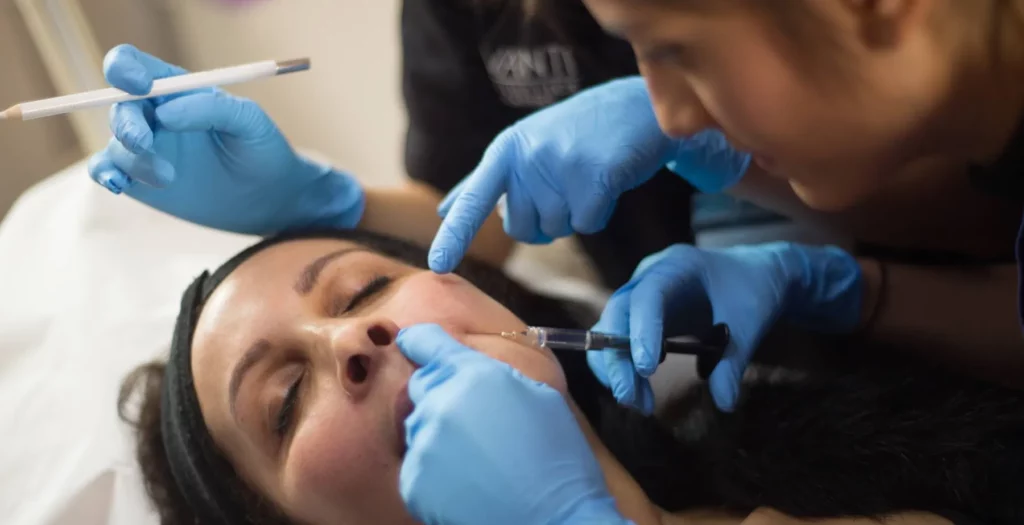
At Avanti Aesthetics Academy, our Fundamental 5 (F5) foundation course is designed specifically for registered medical and healthcare professionals, including GMC-registered doctors. It’s four intensive, practical days:
- Day 1: Upper Face and Advanced Toxin – anti-wrinkle injection techniques for the forehead, glabella, and crow’s feet areas, and all advanced toxin indications for the face, neck and body
- Day 2: Cheek Enhancement, Nasolabial Folds, and Marionettes – dermal filler placement for mid and lower face volumisation
- Day 3: Lip Enhancement – filler techniques for lip augmentation and definition
- Day 4: Clinic Experience Day – you manage a full patient case independently: consultation, treatment plan, pricing, and all procedures, under 1:1 supervision
Every delegate works on a 1:1 student-to-patient ratio. You’re not watching from the back of a lecture theatre. You’re injecting real patients, making clinical decisions, and building muscle memory under direct supervision from Dr Rikin Parekh, who has over 20 years of experience in aesthetic medicine and has trained more than 5,000 delegates.
For doctors specifically, the transition feels natural. You already understand tissue planes, vascular anatomy, and drug mechanisms. You know how to communicate risk to patients. What you’re learning is new technique applied to skills you already have.
After completing the F5 course, many delegates want to keep building confidence before going fully independent. That’s what the Clinic Experience Day is for. It’s day 4 of the programme, but it’s also available as a standalone session for F5 graduates to return to whenever they need it, at £474 per session. Most graduates come back one to three times in their first two to six months. There’s no limit on how often you book.
Ever finished a course and felt like you needed more supervised practice before going solo? That’s exactly what this solves.
Do Doctors Need Additional Qualifications to Practise Aesthetics?
No. As a GMC-registered doctor, you can legally perform non-surgical aesthetic treatments in the UK. You already hold prescribing rights, which means you can independently prescribe and administer prescription-only aesthetic treatments in the same consultation. Under the proposed UK licensing framework for non-surgical cosmetic procedures, regulated healthcare professionals – including doctors – will be able to perform injectable treatments independently (GOV.UK, 2025).
The direction of regulation is clear. The government’s consultation received over 11,800 responses. Of those, 70% reported having had dermal filler treatments and 67% had received anti-wrinkle injections (GOV.UK, 2025). As regulation tightens, unregistered practitioners will face new barriers. Your GMC registration puts you on the right side of that change.
A Level 7 qualification isn’t required to start. Some doctors pursue one later for additional credibility or to access advanced training. But it’s not a prerequisite. Your medical degree, your GMC registration, and your prescribing rights are more than enough to begin.
For a detailed look at qualifications, see our guide on Level 7 qualifications in aesthetics.
How Do You Fit Aesthetics Around Your Medical Career?
Fewer than 10% of GP registrars intend to work as full-time GPs after qualifying (BMA, 2024). That’s a striking number. Portfolio careers are becoming the default, not the exception. Aesthetic medicine fits naturally into that model.
There are three practical models we’ve seen doctors use:
Model 1: Add aesthetics to your existing practice. GPs have the clearest route here. You can offer aesthetic treatments from your surgery premises, or allocate one or two days per week to a dedicated aesthetic clinic within or alongside your practice. Your existing patient base already trusts you. The conversation shifts naturally from routine care to “have you ever considered an anti-wrinkle treatment for those frown lines?”
Model 2: Build a standalone aesthetic clinic. Some doctors, particularly those looking to step back from NHS work, open a dedicated aesthetics space. This takes more upfront investment but gives you full control over your brand, your pricing, and your patient experience. Hospital doctors who reduce their sessions often fund the transition with their remaining NHS income.
Model 3: Locum plus aesthetics. This is popular with younger doctors. You pick up locum shifts for baseline income and flexibility, then run aesthetic clinics on your non-locum days. It keeps your options open while you build a client base.

Whichever model fits your situation, the key is starting. You don’t need to have every detail mapped out before you train. Most of our most successful delegates started with a single clinic day per month and scaled from there as demand grew.
To see how foundation training fits into your broader career plan, visit our training pathways page.
How Do You Get Started?
Over 5,000 delegates have trained with Avanti Aesthetics Academy, and a significant number are GMC-registered doctors who started exactly where you are now. Three steps stand between you and your first aesthetic treatment.
Step 1: Confirm your eligibility. You need an active GMC registration. If you’re registered and in good standing, you’re eligible. No additional prerequisites required.
Step 2: Book your foundation training. The Fundamental 5 course at Avanti Aesthetics Academy covers anti-wrinkle injections and dermal fillers with 1:1 clinical practice on real patients. All training takes place at our Fitzrovia clinic in central London (140 New Cavendish Street, W1W 6YE) and is led by Dr Rikin Parekh. The course is priced at £3,995.
Step 3: Build your clinical experience. After training, you’ll build confidence through the Clinic Experience Day and start treating patients. Many doctors begin by offering treatments to friends, family, and existing patients before expanding through referrals and building an online presence.
If you’d like guidance on which training pathway suits your background, speak to a course advisor. They’ll review your clinical experience and recommend the right starting point.
Phone: +44 (0) 207 096 1088
Frequently Asked Questions
Can doctors legally perform aesthetic treatments in the UK?
Yes. GMC-registered doctors can legally perform non-surgical aesthetic treatments including anti-wrinkle injections and dermal fillers. Unlike most other healthcare professionals, doctors hold prescribing rights from graduation, meaning you can independently prescribe and administer in the same consultation. You’ll need appropriate training, indemnity insurance covering aesthetic procedures, and compliance with GMC guidance on cosmetic interventions and advertising standards.
How long does aesthetics training take?
Foundation training at Avanti Aesthetics Academy takes four days through the Fundamental 5 course. Doctors typically progress quickly because of their existing pharmacology knowledge, patient assessment skills, and comfort with clinical decision-making. Most doctor delegates feel ready to treat core areas confidently by the end of day 3, with day 4 serving as a supervised independent clinic session.
How much does aesthetics training cost?
The Fundamental 5 (F5) foundation course at Avanti Aesthetics Academy is priced at £3,995. This covers four full days of hands-on clinical training with a 1:1 student-to-patient ratio, including anti-wrinkle injections and dermal fillers. Additional Clinic Experience Day sessions are available at £474 per day for graduates who want extra supervised practice.
Can I do aesthetics alongside my NHS role?
Yes, and most doctors do. The most common model is adding one or two aesthetic clinic days per week alongside your NHS commitments. GPs often integrate aesthetics into their existing practice premises. Hospital doctors typically run aesthetic clinics on non-clinical days or weekends. You don’t need to leave the NHS to start earning from aesthetics.
What treatments can I offer after foundation training?
After completing Fundamental 5, you’ll be trained in anti-wrinkle injections for the upper face (forehead lines, frown lines, crow’s feet) and dermal filler treatments including cheek enhancement, nasolabial fold correction, marionette lines, and lip augmentation. These are the highest-demand non-surgical treatments in the UK. Many doctors then progress to advanced training in areas like non-surgical rhinoplasty, jaw contouring, and skin rejuvenation.