

There are 47,022 dentists on the GDC register as of January 2026 (GDC, 2026). Most of them only treat teeth, but a growing number are treating faces too. If you’ve ever considered adding aesthetic treatments to your skill set, your dental background gives you a head start that other healthcare professionals don’t have.
You already understand facial anatomy at a level that takes other practitioners months to learn. You give injections in the perioral and facial region every single day. Your patients already trust you with their appearance. The gap between where you are now and where you could be in aesthetics is smaller than you might think.
This guide breaks down why dentists are so well-positioned for aesthetics, what the earning potential looks like, and what training actually involves.
Key Takeaways
- The UK aesthetics market is worth £3.6 billion and growing at 8–9% annually (AestheticSource, 2026)
- Self-employed aesthetic practitioners earn £60,000–£150,000+, compared to an average of £78,200 for self-employed dentists (NHS Digital, 2024)
- Dentists already perform 10+ distinct facial injection techniques daily (NCBI, 2024)
- GDC registration means you’re already eligible for foundation aesthetics training with no additional prerequisites

Why Are So Many Dentists Moving Into Aesthetics?
The UK aesthetics market is now worth an estimated £3.6 billion, with non-surgical treatments growing at 8–9% year on year (AestheticSource, 2026). Around 900,000 anti-wrinkle injection treatments are performed annually in the UK alone (PolicyBee, 2025). That’s not a side market. It’s a major sector, and it’s pulling in clinical professionals from across healthcare.
Dentists are particularly well represented in this shift. Why? Because the crossover between dental practice and aesthetic medicine is closer than most people realise. You don’t need to retrain from scratch. You need to redirect skills you already use every day.
Globally, non-surgical procedures now account for 54% of all aesthetic treatments performed, with 20.5 million procedures recorded in 2024 (ISAPS, 2024). Dermal filler treatments alone grew by 5.2% to reach 6.3 million procedures worldwide that same year. The demand isn’t slowing. Patients want these treatments, and they’re increasingly looking for qualified medical professionals to deliver them.
Have you noticed more patients asking about non-surgical cosmetic treatments during dental appointments? That’s the market coming to you.
What Advantages Do Dentists Have in Aesthetics?
Dentists routinely perform at least 10 distinct injection and nerve block techniques as part of daily practice, including inferior alveolar nerve blocks, infraorbital nerve blocks, and mental nerve blocks (StatPearls/NCBI, 2024). That’s more facial injection experience than most other healthcare professionals accumulate in years of aesthetics work. It’s a genuine advantage, and it shows in the speed at which dentists typically pick up aesthetic techniques.
Your dental degree gave you something else that’s hard to replicate: deep facial anatomy knowledge. The Anatomical Society’s core syllabus for UK dental undergraduates contains 147 learning outcomes, with head and neck anatomy receiving the strongest emphasis (Anatomical Society/PMC, 2020). You’ve studied the skull, mandible, temporomandibular joint, infratemporal fossa, nasal cavity, oral cavity, and orbital structures in detail. That’s the exact anatomy map that aesthetic practitioners need.
Here’s what this means in practice. When other professionals are learning where the facial artery runs or how the orbicularis oculi responds to toxin, you already know. You’ve dissected it. You’ve studied it for exams. You use that knowledge every time you give a nerve block or plan an extraction.
On top of that, your existing patient base is an immediate advantage. These are people who already trust you with their face. The consultation conversation shifts naturally from “your teeth look great” to “have you ever considered an anti-wrinkle treatment for those frown lines?” It’s not a hard sell. It’s an extension of care you already provide.
In our experience training over 5,000 delegates, dentists consistently pick up injection techniques faster than other professional groups. It’s not surprising. You’re already comfortable with needles, syringes, and the perioral anatomy that most aesthetic treatments target.
How Much Can Dentists Earn From Aesthetics?
The average taxable income for self-employed dentists in England was £78,200 in 2023/24, a 3.2% increase from the previous year (NHS Digital, 2024). Foundation dentists start at £40,776 (NHS Health Careers, 2024). Practice-owning principals average around £121,200, while associates sit closer to £65,500 (Department of Health NI, 2024). These are reasonable numbers. But aesthetics can sit on top.
Self-employed aesthetic practitioners in the UK earn between £60,000 and £150,000 or more, depending on their client volume, treatment range, and whether they run their own clinic. Some dentists add aesthetics as a supplementary income stream within their existing practice, earning an additional £20,000–£50,000 per year from just one or two clinic days per week. Others build standalone aesthetic clinics and generate six-figure revenue.
We should be straightforward about this. You won’t earn £150,000 in your first year. Building a client base takes time and consistency. But the trajectory is different from dental practice, where your income is largely capped by UDA targets or chair time. In aesthetics, your earnings scale with your skill, reputation, and the number of patients you can see.
What would an extra £30,000 per year mean for your practice? For some dentists, that’s the difference between staying afloat and thriving.
What Does Aesthetics Training for Dentists Involve?
Foundation aesthetics training covers the two most in-demand non-surgical procedures in the UK: anti-wrinkle injections and dermal fillers. Together, these treatments account for the bulk of the £3.6 billion UK aesthetics market (Bespoke Advantage, 2025). If you’re going to learn aesthetics, these are the skills that will generate income from day one.
At Avanti Aesthetics Academy, our Fundamental 5 (F5) foundation course is designed specifically for registered medical and healthcare professionals, including GDC-registered dentists and dental hygienists. It’s four intensive, practical days:
- Day 1: Upper Face and Advanced Toxin – anti-wrinkle injection techniques for the forehead, glabella, crow’s feet areas, and all advanced toxin indications for the face, neck and body.
- Day 2: Cheek Enhancement, Nasolabial Folds, and Marionettes – dermal filler placement for mid and lower face volumisation
- Day 3: Lip Enhancement – filler techniques for lip augmentation and definition
- Day 4: Clinic Experience Day – you manage a full patient case independently: consultation, treatment plan, pricing, and all procedures, under 1:1 supervision
Every delegate works on a 1:1 student-to-patient ratio. You’re not watching a demonstration from across the room. Every day you’re injecting real patients, making clinical decisions, and building confidence under direct supervision from Dr Rikin Parekh, who has over 20 years of experience in aesthetic medicine and has trained more than 5,000 delegates.
For dentists specifically, the learning curve tends to be steep in the best possible way. You’ve already done thousands of injections. You know how to aspirate. You understand tissue planes. What you’re learning is new applications of skills you already own.
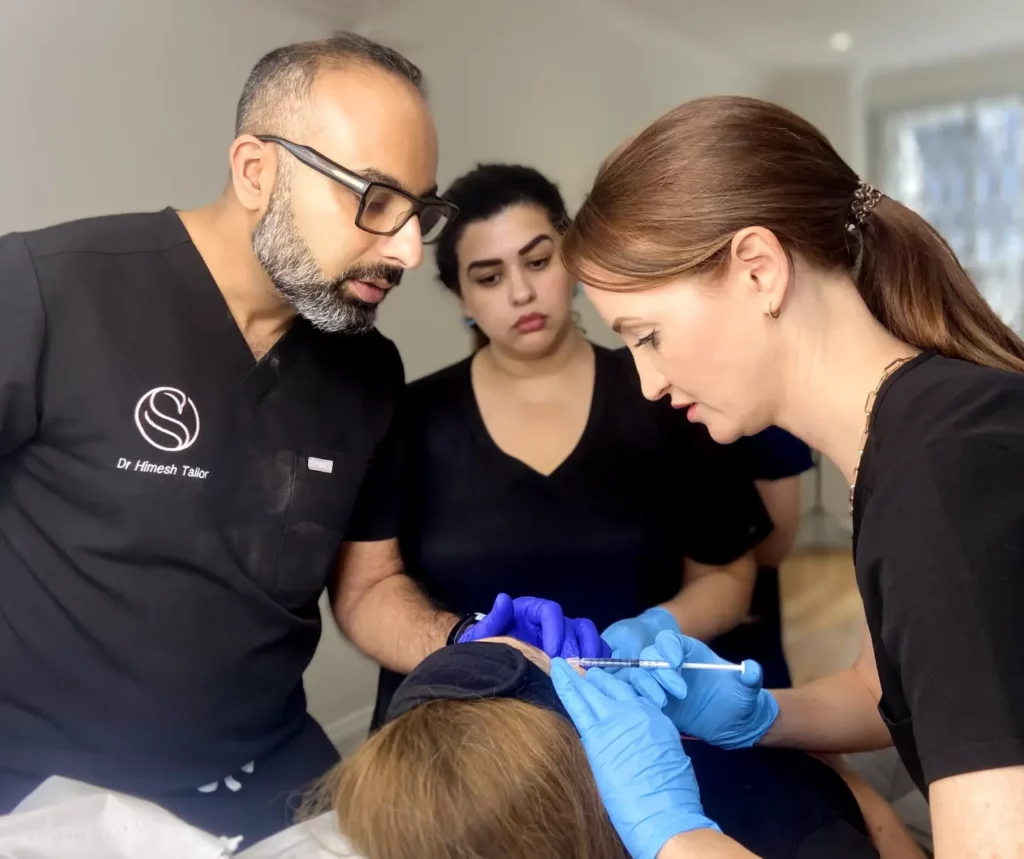
After completing the F5 course, many delegates want to keep practising before they go fully independent. That’s what the Clinic Experience Day is for. It’s day 4 of the programme, but it’s also available as a standalone session for F5 graduates to return to whenever they need it, at £474 per session. Most graduates come back one to three times in their first two to six months. There’s no limit on how often you book, and you’ll always have a dedicated trainer with you.
It’s one of the most common questions we get: “What if I finish the course and don’t treat anyone for a few weeks?” The Clinic Experience Day is the answer. Your skills stay sharp. Your confidence stays high.
Do Dentists Need a Level 7 to Practise Aesthetics?
Short answer: no. There’s no legal requirement in the UK for a Level 7 qualification to perform non-surgical aesthetic treatments if you’re already a registered healthcare professional. As a GDC-registered dentist, you’re already regulated. You have the clinical governance framework, the indemnity insurance, and the professional accountability that patients and regulators expect.
That said, regulation is shifting. The UK government has confirmed a new licensing framework for non-surgical cosmetic procedures, following a consultation that received over 11,800 responses (GOV.UK, 2024). Of those respondents, 70% reported having had dermal filler treatments and 67% had received anti-wrinkle injections. The direction of travel is clear: regulation is tightening, and registered professionals will be the ones who benefit.
Does a Level 7 add value? It can. Some dentists pursue it later in their aesthetics career for additional credibility and advanced skills. But it’s not a prerequisite for starting. Your GDC registration already puts you ahead of the curve.
For a deeper look at this topic, see our guide on Level 7 qualifications in aesthetics.
How Do You Fit Aesthetics Around a Dental Career?
Most dentists don’t drop everything to go full-time in aesthetics. In our experience, the most common approach is adding aesthetic treatments to an existing dental practice, starting with one or two days per month. Around 13.9 million UK adults are either considering or have already had non-surgical aesthetic treatments (Bespoke Advantage, 2025). Your waiting room is already full of potential aesthetic patients.
There are three practical models we’ve seen dentists use:
Model 1: Add aesthetics to your existing practice. This is the lowest-risk option. You allocate one or two days per month to aesthetic treatments within your dental surgery. Your overheads are already covered. Your patient base is already there. You’re simply adding a new revenue stream to an existing operation.
Model 2: Build a separate aesthetic clinic. Some dentists open a dedicated aesthetics space, either within their dental practice building or at a separate location. This takes more investment but allows you to build a distinct aesthetic brand and attract patients specifically seeking cosmetic treatments.
Model 3: Offer mobile or partnership sessions. A few dentists work from shared clinic spaces, renting treatment rooms by the day. It keeps overheads low while you build your client base and reputation.

Whichever model you choose, the key is starting. You don’t need to have every detail figured out before you train. Many of our most successful delegates started with a single aesthetic treatment day per month and scaled up from there as demand grew.
To see how foundation training fits into your broader career plan, visit our training pathways page.
How Do You Get Started?
Over 5,000 delegates have trained with Avanti Aesthetics Academy, and many of them are GDC-registered dentists, dental hygienists and dental therapists who started exactly where you are now. Three steps stand between you and your first aesthetic treatment.
Step 1: Confirm your eligibility. You need an active GDC registration as a dentist, dental hygienist, or dental therapist. If you’re registered and in good standing, you’re eligible. No additional prerequisites required.
Step 2: Book your foundation training. The Fundamental 5 course at Avanti Aesthetics Academy covers anti-wrinkle injections and dermal fillers with 1:1 clinical practice on real patients. All training takes place at our Fitzrovia clinic in central London (140 New Cavendish Street, W1W 6YE) and is led by Dr Rikin Parekh. The course is priced at £3,995.
Step 3: Build your clinical experience. After training, you’ll build confidence through the Clinic Experience Day and start treating patients. Many dentists begin by offering aesthetic treatments to existing patients before expanding their client base through word of mouth and online presence.
If you’d like guidance on which training pathway suits your background, speak to a course advisor. They’ll review your clinical experience and recommend the right starting point.
Phone: +44 (0) 207 096 1088
Frequently Asked Questions
Can dentists legally perform aesthetic treatments in the UK?
Yes. GDC-registered dentists are legally permitted to perform non-surgical aesthetic treatments in the UK, including anti-wrinkle injections and dermal fillers. Your GDC registration places you within a regulated professional framework, which means you already meet the clinical governance requirements that upcoming licensing legislation will enforce. You’ll need appropriate training, indemnity insurance that covers aesthetic procedures, and compliance with advertising standards.
How long does aesthetics training take for dentists?
Foundation training at Avanti Aesthetics Academy takes four days through the Fundamental 5 course. Because dentists already have extensive injection experience and facial anatomy knowledge, the learning curve is typically steeper than for other healthcare professionals. Most delegates feel confident performing core treatments by the end of day 3, with day 4 serving as a supervised independent clinic session.
How much does aesthetics training cost?
The Fundamental 5 (F5) foundation course at Avanti Aesthetics Academy is priced at £3,995. This covers four full days of hands-on clinical training with a 1:1 student-to-patient ratio, including anti-wrinkle injections and dermal fillers. Additional Clinic Experience Day sessions are available at £474 per day for F5 graduates who want extra supervised practice.
Can dental hygienists and dental therapists train in aesthetics too?
Yes. GDC-registered dental hygienists and dental therapists are eligible for foundation aesthetics training at Avanti Aesthetics Academy. As of July 2024, there are 9,177 dental hygienists and 5,558 dental therapists on the GDC register (GDC, 2024). All GDC-registered professionals who meet the eligibility criteria can enrol in the Fundamental 5 course.
What treatments can dentists offer after foundation training?
After completing the Fundamental 5, you’ll be trained in anti-wrinkle injections for the upper face (forehead lines, frown lines, crow’s feet), all advanced toxin indications and dermal filler treatments including cheek enhancement, nasolabial fold correction, marionette lines, and lip augmentation. These are the highest-demand non-surgical treatments in the UK, covering the core skills you need to start generating revenue from aesthetics immediately.